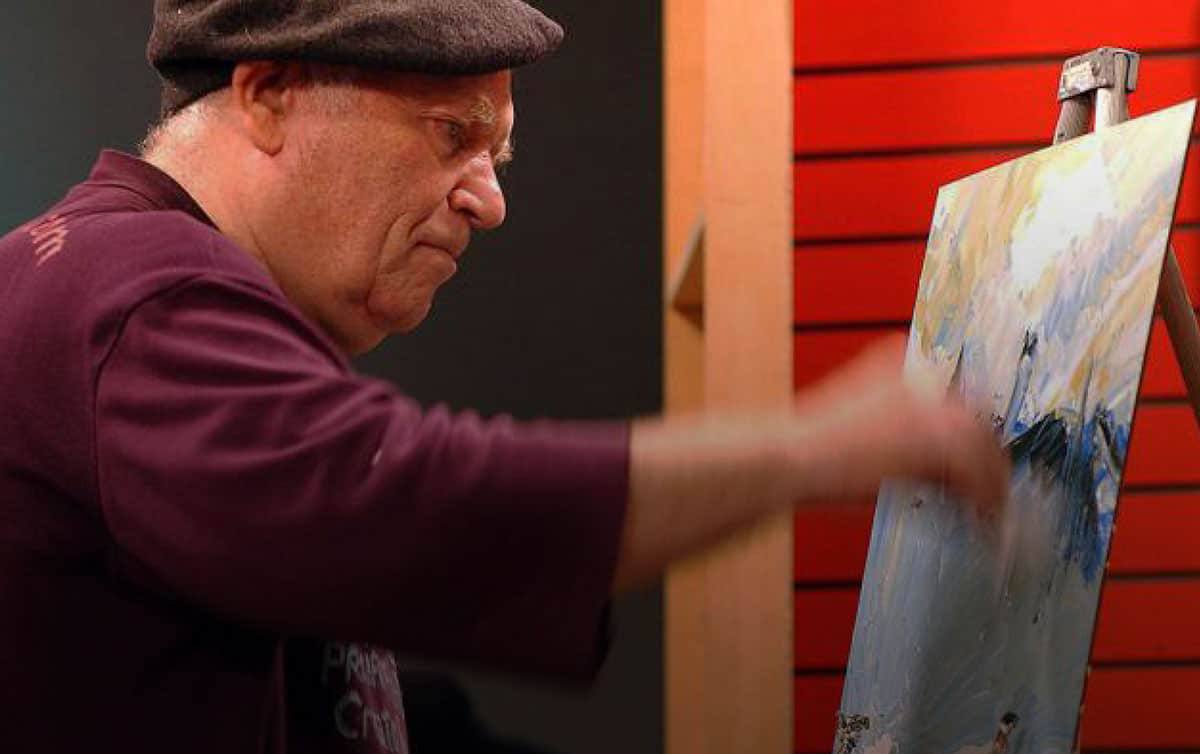

Born in Poland and passed away in the Bronx, Morris Katz was a talented and eccentric artist and a two-time Guinness World Record holder. Thanks to his unusual painting technique, where he used a palette knife and toilet paper instead of a brush, he earned the nickname “King of Schlock Art.” But his accomplishments included many other significant achievements. Let’s take a closer look at the life of this artist on i-bronx.com.
From a Camp to the Canvas
Morris Katz was born on March 5, 1932, in Galicia, which was then part of Poland. His childhood was exceptionally difficult and tragic. When World War II began, young Morris found himself in the midst of horrific events. During the Holocaust, he survived the hell of Nazi concentration camps, including Auschwitz—a place that left permanent scars on his memory. Most of his family perished, and this pain stayed with Morris Katz throughout his life.
After the war, the teenager found himself in a displaced persons camp in Germany. Life there was hard and uncertain, but it was at that time that art entered his life. At age 13, he began studying painting with Dr. Hans Vockler from the Munich Academy. This introduction was Morris’s first step into the world of creativity, which gave him new hope after the terror he had endured.
In 1949, when Katz was seventeen, he traveled to the United States in search of a new life. Arriving in New York, he first attended classes at the prestigious Art Students League while earning a living as a carpenter. However, the more he immersed himself in the world of art, the more clearly he realized that painting wasn’t just a hobby but his true calling, a pursuit to which he was ready to dedicate his life.

“I decided shortly thereafter that I was good enough—compared to others, good enough—to make a living as a painter,” he later recalled.
For Morris Katz, art was never limited to just creating a canvas. He transformed the painting process into a unique stage performance, where every stroke was part of a show. His paintings were born before the eyes of the public with astonishing speed, in a matter of minutes, and this was always accompanied by a dramatic, almost theatrical style of work. Katz jokingly compared his technique to “schmear-painting a bagel,” emphasizing the ease and spontaneity of his movements. New York Magazine called his performances a “solo vaudeville act,” as they combined humor, charisma, technical skill, and inexhaustible energy.
A New Technique and Unique Paintings
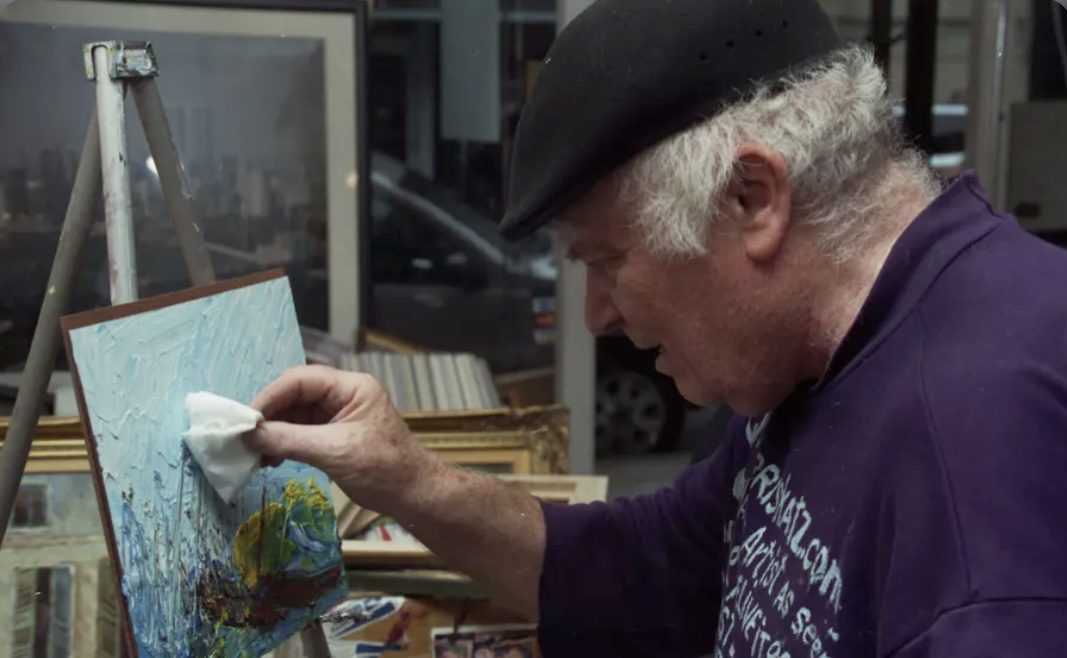
In the mid-1950s, Morris Katz did what most artists would find unthinkable: he gave up brushes. In 1956, while working on his unpublished “Dictionary of Color,” he began using a palette knife, experimented with rags, and eventually switched to the material that brought him worldwide fame: toilet paper. His unique technique, which he called “instant art,” allowed him to create paintings with astonishing speed. At the height of his popularity, Katz could line up dozens of canvases, pace back and forth in front of them, and apply paint with a palette knife or a crumpled piece of toilet paper, using nearly 10,000 rolls a year.
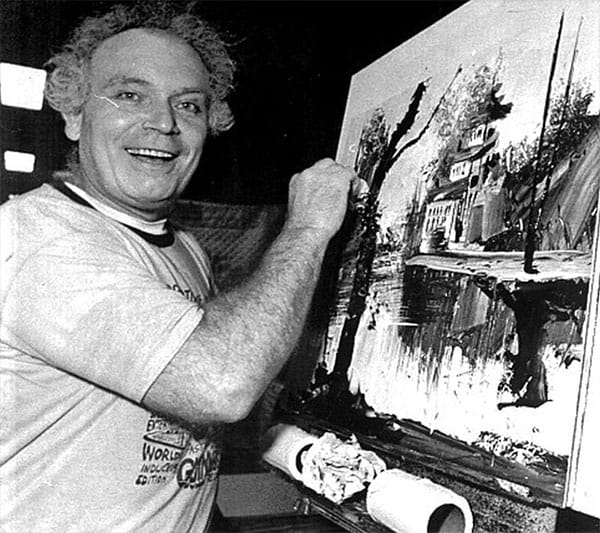
In his 1985 autobiography, Paint Good and Fast, Katz explained his method. He would apply paint to the canvas with a palette knife, smearing it to create the overall color scheme, and use toilet paper to add details—rocks on a beach, mountain peaks, clouds, or leaves on trees. For over half a century, he demonstrated this approach to audiences around the world.
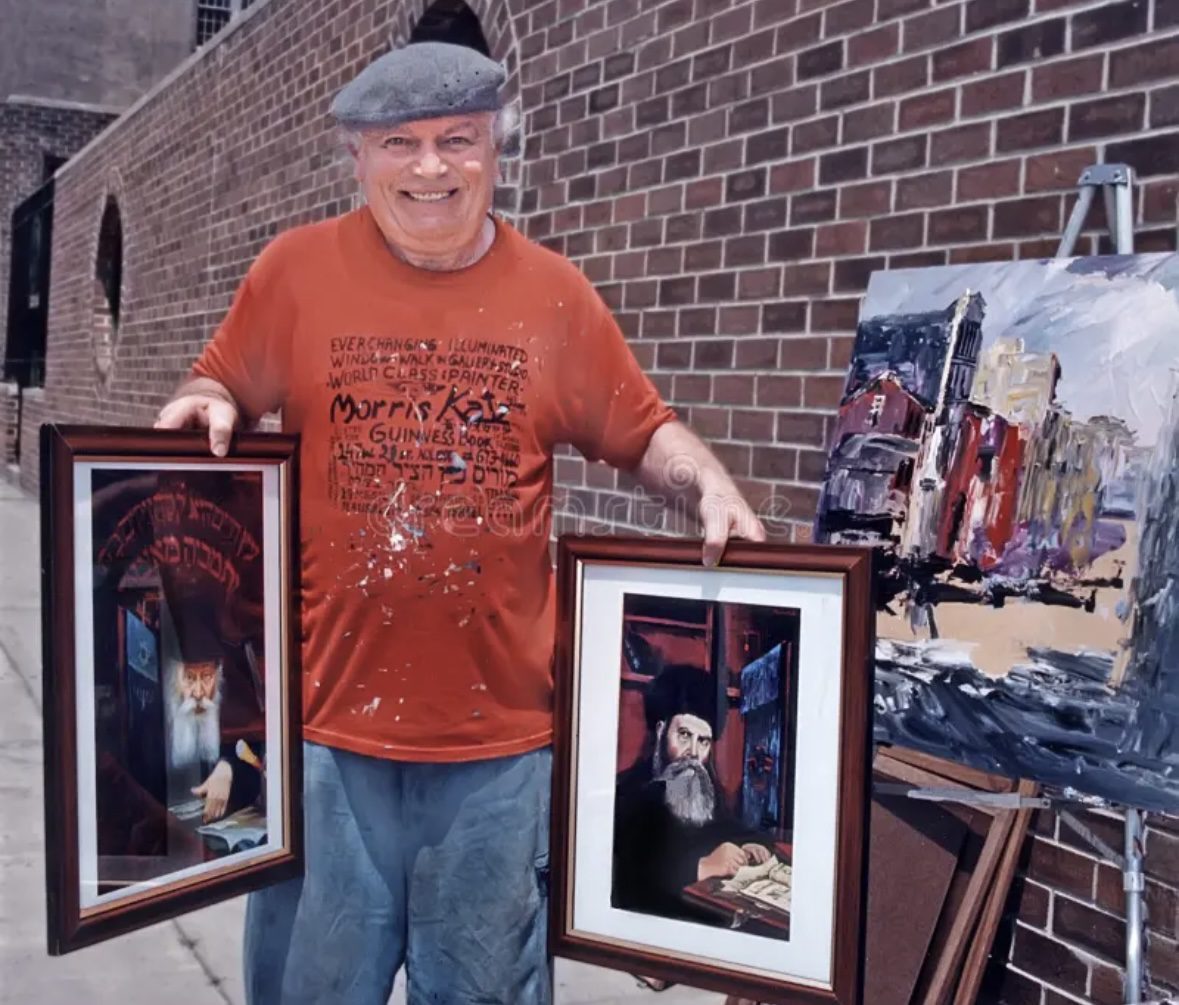
However, behind the persona of the “King of Schlock Art” was a serious artist. After President John F. Kennedy’s assassination in 1963, Morris Katz painted his portrait, which marked the beginning of a massive “Presidential Collection.” This was a gallery of detailed and moving portraits of all U.S. presidents—from George Washington to George Bush. For each work, Katz meticulously reproduced the historically accurate flag, from Washington’s thirteen stars to the fifty stars of the modern era. His paintings were reproduced on millions of postcards, and the project itself became a tribute of gratitude to America, which had given him refuge and freedom after the war.
In 1965, recognition also came from the Vatican—among five hundred artists, Morris was chosen to create a portrait of Pope Paul VI. Reproductions of this work sold over three million copies worldwide.
“When you look at one of his paintings, you see the history behind it,” recalls Alex Weiser, the director of public programs at YIVO. “He was an artist for the people. He was not an untouchable artist who no one really knows. He was connected to this whole era of Jewish history, and so many people, including my paternal grandmother, met him.”
Amazing Records
Morris Katz never limited himself to just painting—he turned it into an exciting race against time. His incredible speed was so impressive that viewers sometimes couldn’t follow his every move. On May 9, 1988, this talent was officially immortalized in history. Morris Katz entered the Guinness Book of World Records for creating a 12×16-inch painting in just 30 seconds. A soft and moving image of a child appeared on the canvas, a stark contrast to the incredible speed of his execution.
Speed had been Katz’s signature long before this record. Back in 1987, during a charity event for the Boy Scouts of America, he astonished everyone by creating 103 paintings in 12 hours. The atmosphere was so uplifting that 55 of them found new owners right at the event.
Throughout his creative life, Morris Katz set two Guinness World Records: the first for the fastest painting ever created, and the second for the largest number of works produced. In this, he even surpassed Pablo Picasso. His colossal creative legacy includes over 280,000 paintings. The artist’s works now adorn the collections and exhibitions of more than a hundred museums worldwide, including the famous Smithsonian Institution, which is considered one of the most prestigious cultural centers on the planet.
The Charismatic Artist
But Morris Katz’s talent extended far beyond his artistic skill. He was a comedian, a TV host, a producer, and the creator of over 600 TV shows where he demonstrated his unique “instant art” method.
His tours were transformed into genuine performances. In Borscht Belt hotels, at conventions, and during charity events, Katz would paint landscapes, seascapes, city buildings, flowers, animals, rabbis, children, and even clowns with incredible speed. His performances often had a charitable purpose. He constantly painted, donated his work, and raised money for hospitals. Morris Katz’s style was unique not only in its technique but also in its delivery. With his strong European accent, he would crack jokes in English and Yiddish, making the audience laugh while new canvases appeared before their eyes in minutes. He would then hold impromptu auctions, selling the paintings for $50–150.
Morris was a natural showman, a wonderful storyteller, and a master of anecdotes.
“People loved to be around him, and he loved to perform for an audience,” his acquaintances recalled. Eddy Portnoy of YIVO described him as a “weird underground hero” and a “very funny character,” while for Duvi Honig, the founder of the Orthodox Jewish Chamber of Commerce, he was “an extremely proud Jew and an American patriot who selflessly dedicated himself to being thankful and contributing to America and the freedoms it stands for.”
On November 12, 2010, Morris Katz passed away in the Bronx at the age of 78 after suffering a stroke. A foundation was established in his honor to commemorate this American-Jewish legend and his contributions to the country’s history, culture, and economy. The life of Morris Katz was a blend of art, humor, and sincere dedication to people.