
It is unlikely that you remember the International Exposition of Science, Arts and Industries, which took place in the Bronx in 1918. In addition to the fact that between its holding and the beginning of the XXI century, more than 80 years have passed, it was not a memorable event. In 1853, the audience was shown an elevator and a television was presented in 1939-1940. As for the Exposition in 1918, it could hardly be called international, as, apart from the USA, only Brazil took part in it (other countries participated in the war and could not pay attention to such things). However, the event took place and had an impact on the further development of the Bronx. That is why i-bronx.com tells you more about the International Exposition of Science, Arts and Industries in 1918.
The beginning of the Exposition
As noted by boweryboyshistory, in 1914, in New York, or rather in the Bronx, it was decided to hold the International Exposition of Science, Arts and Industries. At that time, this borough was growing rapidly, a subway was built here, a courthouse was completed and real estate prices were rising. The locals wanted more, namely to attract foreign trade to their country after the war and to draw attention to their newly independent borough. That is why it was decided to hold the International Exposition here.
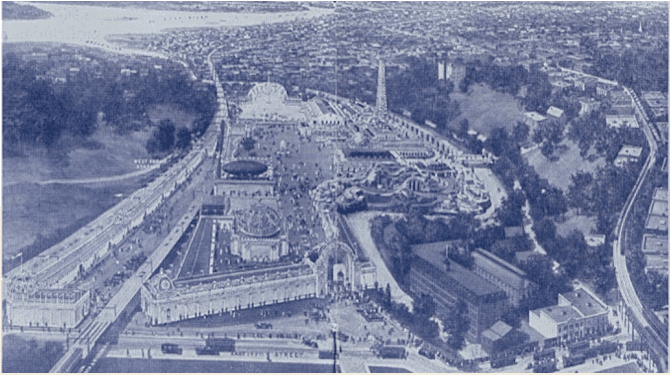
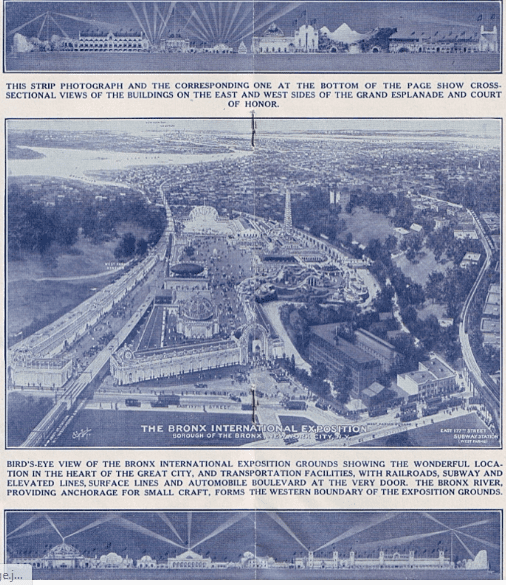
The West Farms area was chosen as the place for the exhibition. It was located in the south-central part of the Bronx, on the banks of the Bronx River. There was a metro station and one could also get there by ferry. The estate of politician William Waldorf Astor became the center of the Exposition.
Difficulties began to haunt the event from the first days. The decision to hold it was made in 1914, but the war began, which adjusted the plans of the organizers. The latter, by the way, did not believe that it would last long. They were optimistic. When on August 1, 1916, the foundation of the buildings for the exhibition was laid, the war was still going on. A few days before, the explosion of the Black Tom warehouse in New York harbor caused destruction and death. Therefore, the US Congress refused to provide money for the exhibition. Then, there was another obstacle. The New York, Westchester and Boston Railroad announced its refusal to build a train station near the venue, even though the line was very close. Still, the work continued. In November 1917, land was bought for the entrance to the exhibition.
Opening of the event
The Bronx has been making its way to the Exposition for many years, not only since 1874 when its separate parts were included in New York. When the organizers decided to hold the exhibition, they wanted to dedicate it to the 300th anniversary of the Bronx. They wanted to open the exhibition in 1917. However, it is not clear why they thought so, because there is recorded data that Jonas Bronck, the first settler, arrived here in 1638.
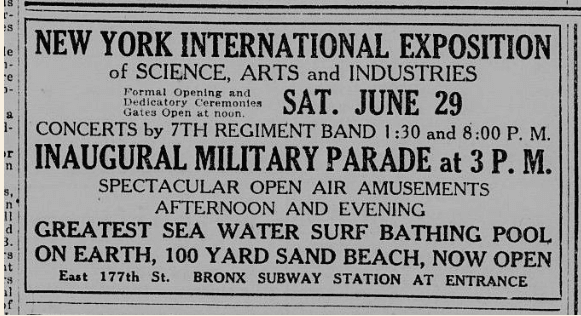
Still, the exhibition was opened a month later on June 30, 1918. The delay was due to the war. At the time of opening, many buildings were not completed. The vast majority of them were never finished. One of the visitors wrote that the fairgrounds had about 12 buildings, a number of concessions, including a restaurant, roller coasters, centrifugal swings and a silly-looking house.
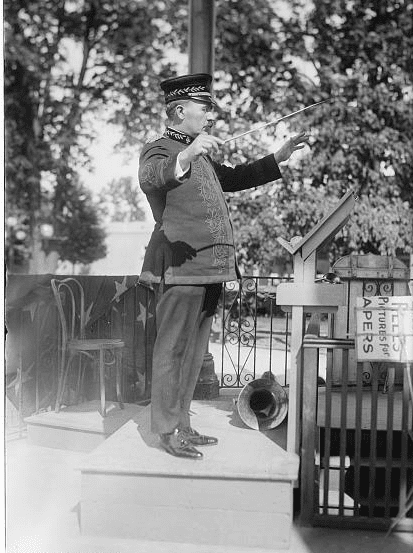
Several thousand people came to the opening ceremony. H. F. McGarvey, president of the Exposition, handed over the keys to Police Commissioner Pichard E. Enright, as Mayor Heelan was unable to attend the event.
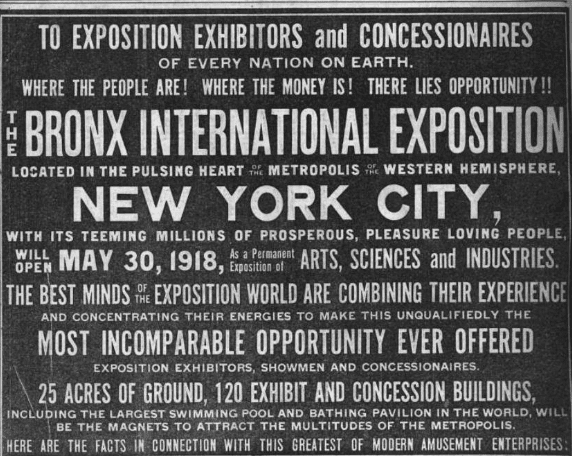
The Exposition
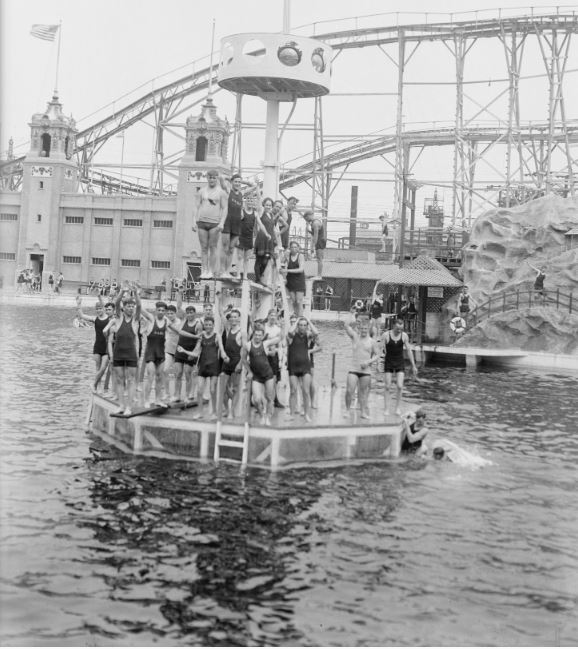
The exhibition was located on a 28-acre (11 ha) site at 177th Street and Devoe Avenue. It featured a 4,500-person swimming pavilion, the Circle de Papillon private club and the world’s largest surf pool. The pool measured 300 by 350 feet (91 by 107 m), held 2,500,000 gallons of water, had a depth of 10 feet and a beach of 15 by 17 meters with real sea sand. There were also diving boards and a machine that created waves. There were so few interesting inventions that until August, advertising headlines in the media were mainly about the work of the pool: ‘Hawaiians repeat the triumph on the tank’.
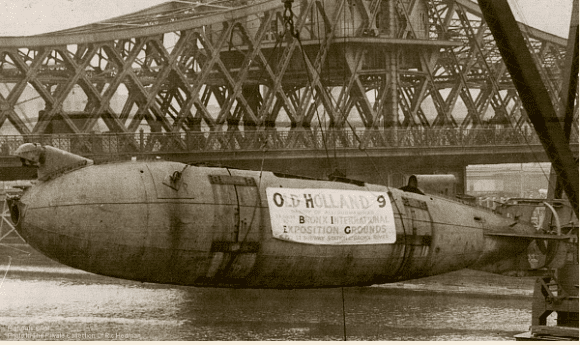
Still, the exhibition could boast of Madame Torelli’s Comedy Circus, the Lunette Sisters (they were also called spinning geisha girls) and diver Kearney P. Speedy. Newspapers also reported a ‘monkey cabaret’ and a small submarine named Holland, one of the first to be adopted by the US Navy.
In addition, the exhibition featured a miniature railway, a mountain waterfall (20 meters high) and a hotel. Entrepreneur LaMarcus Adna Thompson built a roller coaster especially for the event and the Ferris wheel was transported from the World Panama-California Exposition. Among the buildings intended for other nations and joint meetings, a conference hall and thematic pavilions were built, which reflected the history and culture of China, the North Sea and fine arts.
Thousands of people visited the exhibition during the summer. At the beginning of September, its popularity decreased and most of the entertainment was closed.
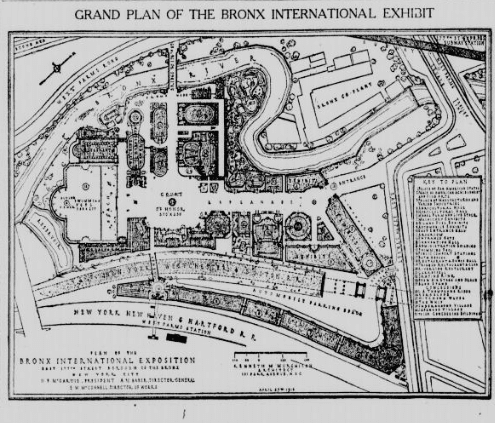
Place for the Exposition after 1918
The efforts of the exhibition organizers to squeeze more out of it contributed to its reorganization. The exhibition hall was turned into a skating rink, although before that culinary masterpieces were demonstrated here and the equipment was offered to be viewed.
In the following year, it was decided to turn the exhibition area into an amusement park. It was called Starlight Park. It became a popular hangout for Bronx children. Thousands of people visited the former exhibit over 20 years. A large Colosseum stadium was built on the territory of the park, which could accommodate 15,000 spectators. Football matches were held there with the participation of the New York Giants (the latter has made this stadium its home since 1923).
The turbulent 1930s came with their economic depression and decline. Most attractions were closed, only the pool was open. The children of the workers came here for the opportunity to enjoy sunbathing, picnics and moonlight dancing to live music.
In 1931, one of the first Bronx radio stations, WKBQ, appeared on the territory of the park.
In the following years, the park slowly degraded. It was turned into a truck parking lot. With the beginning of the Second World War, part of the park was occupied by the US Army. This continued until 1946. Buses stood on the other side. In the late 1940s, there was a fire here that destroyed its best attractions. The construction of the Cross Bronx Expressway was performed 20 years later by Robert Moses. It completely erased any mention of the park and the exhibition.
In the 1950s, a new Starlight Park was opened across the river from the original park. A playground now exists on this site.
Thus, the desire of New Yorkers to attract investments to their city, to revive international trade and to accelerate the growth of real estate prices enabled them to open the International Exposition of Science, Arts and Industries. However, the First World War stood in the way of its full implementation. The exhibition failed and did not have the expected outcome.