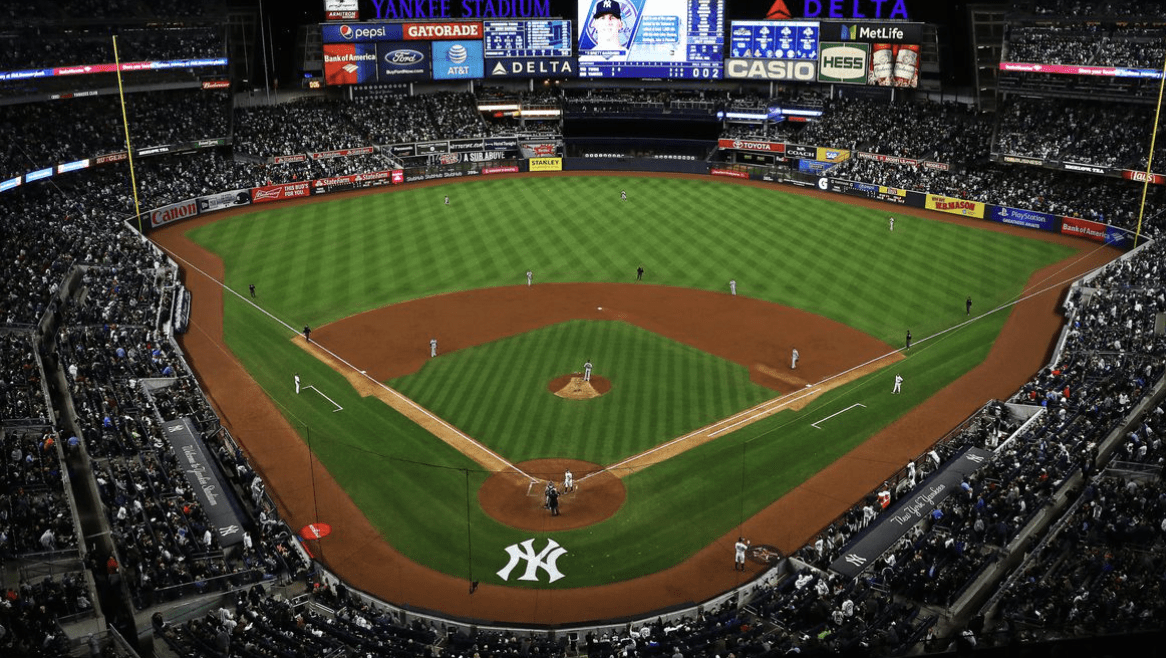

The first Yankee Stadium was built over 100 years ago. In the late ’80s, it underwent a massive renovation, and just 30 years later, it was completely torn down. How could a team demolish the home stadium of the legendary Yankees? They did it to build a new, even better, and more modern arena for baseball stars and more. In this article on i-bronx, we’ll tell you how it all happened and how the iconic stadium in the Bronx changed.
Long Backroom Discussions About Building a New Stadium
The owner of the New York Yankees, George Steinbrenner, started talking about a new stadium as early as the 1980s, shortly after the renovated arena opened. At the time, he was considering a move to the Meadowlands sports complex in New Jersey. In 1984, New Jersey Governor Thomas Kean even approved the use of land for a new baseball stadium, but lawmakers couldn’t find the funds for its construction. In a 1987 referendum, New Jersey residents rejected a proposal to allocate $185 million to finance a stadium for the Yankees. Steinbrenner hid this information and continued to threaten to move the team to pressure New York City.

In 1988, Mayor Ed Koch agreed to spend $90 million from the city budget to upgrade the stadium, but Steinbrenner insisted on a larger budget and a new facility. In 1993, Mayor David Dinkins proposed expanding the project to include new housing and other facilities in the Bronx area. That same year, New York Governor Mario Cuomo suggested using the West Side Yard for a new stadium, but he lost the election a few months later, even though his proposal was very appealing to Steinbrenner.
In 1998, Bronx Borough President Fernando Ferrer announced he would allocate $600 million for a stadium upgrade, but Steinbrenner again refused. The plan to move the Yankees to the West Side Yard was brought back into discussion. Mayor Rudy Giuliani announced preliminary agreements for the construction of new stadiums for the Yankees and Mets, which would cost a total of $2 billion.
Final Efforts and Obstacles
But in 2002, Michael Bloomberg came to power and stated that the city could not afford to build new stadiums. After long negotiations at various levels, the mayor finally agreed. In 2004, plans for two new stadiums were unveiled. Over several years of discussion and debate, the planned construction costs had grown significantly. The total cost for the Yankee Stadium alone was $2.3 billion, of which $1.2 billion came from public subsidies, making it one of the most expensive stadiums in global history.
The groundbreaking ceremony took place on August 16, 2006, on the 58th anniversary of Babe Ruth’s death. Among those present were George Steinbrenner, Mayor Michael Bloomberg, and the then-Governor of New York.
During construction, a few malicious acts by fans of other clubs were recorded. One construction worker buried a replica of a David Ortiz jersey from the Boston Red Sox, attempting to place a “curse” on the Yankees. Another worker claimed to have buried a scorecard from the 2004 American League Championship Series under the foundation to bring bad luck to the Yankees in all future games. However, these actions didn’t affect the team’s results: the Yankees won the 2009 World Series in their first season at the new stadium.
Preserving Tradition with Modern Design
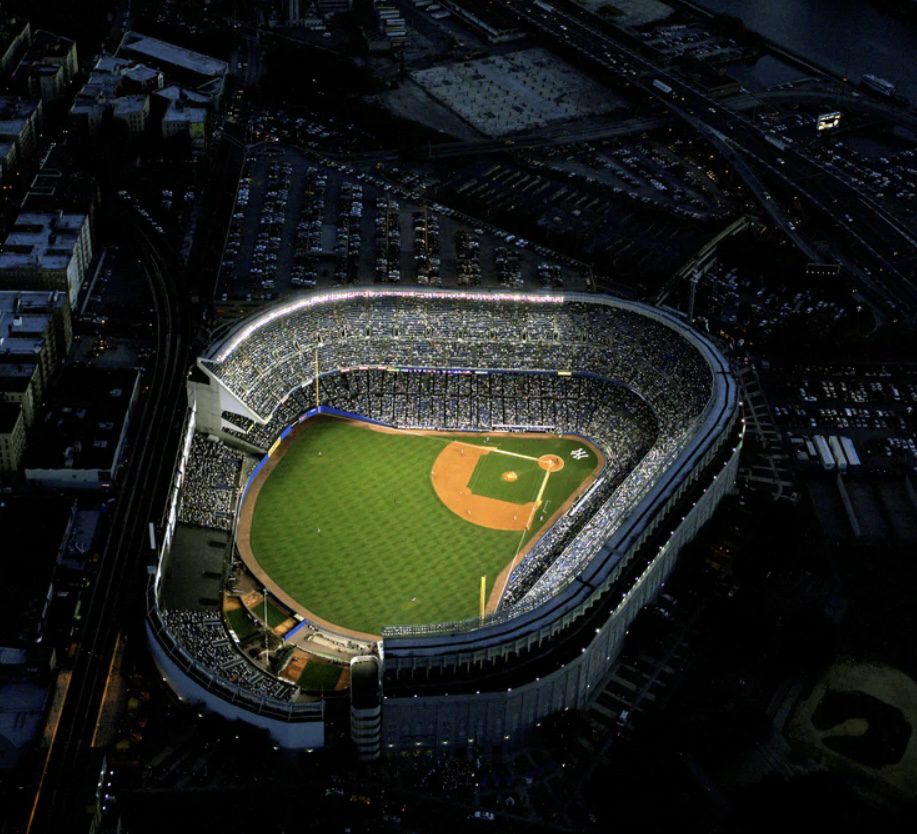
The new stadium was designed to incorporate elements of the original 1923 structure. From the outside, it resembles the old stadium, while the interior has a modern baseball field with more space and improved infrastructure.
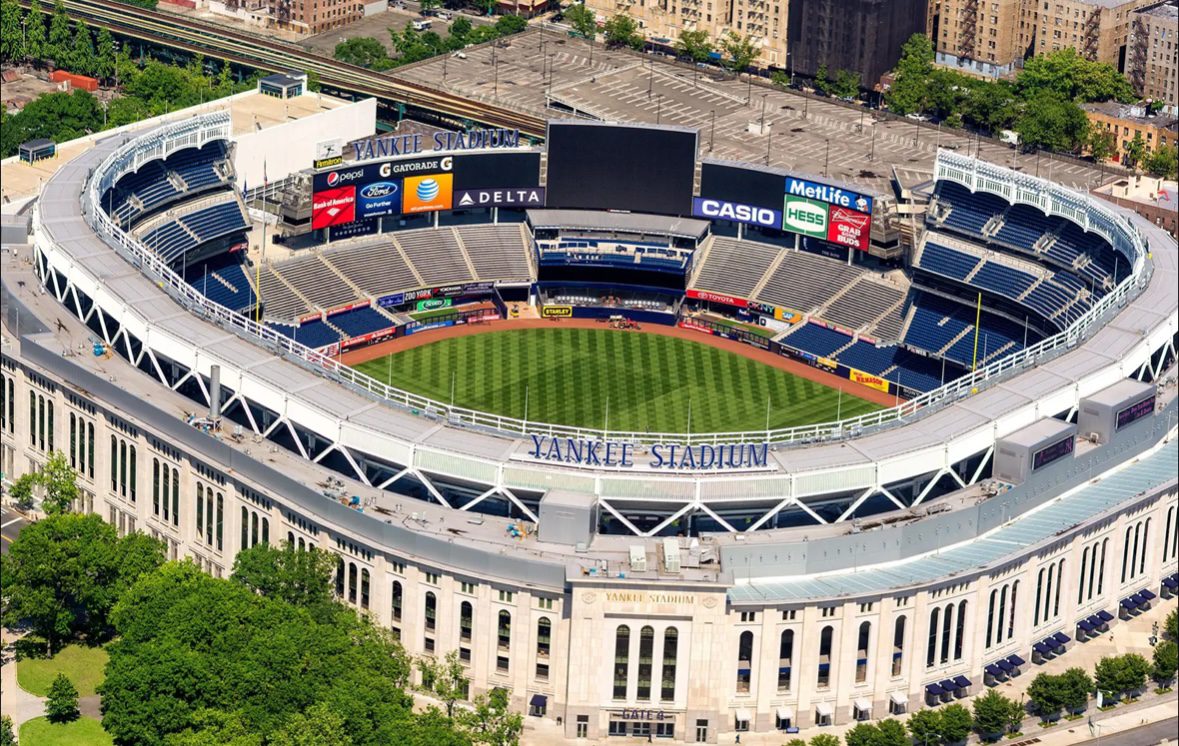
The architectural firm Populous designed the stadium using 11,000 fragments of Indiana limestone, granite, and precast concrete. The limestone for the stadium, by the way, came from the same quarry as the one used for the Empire State Building.
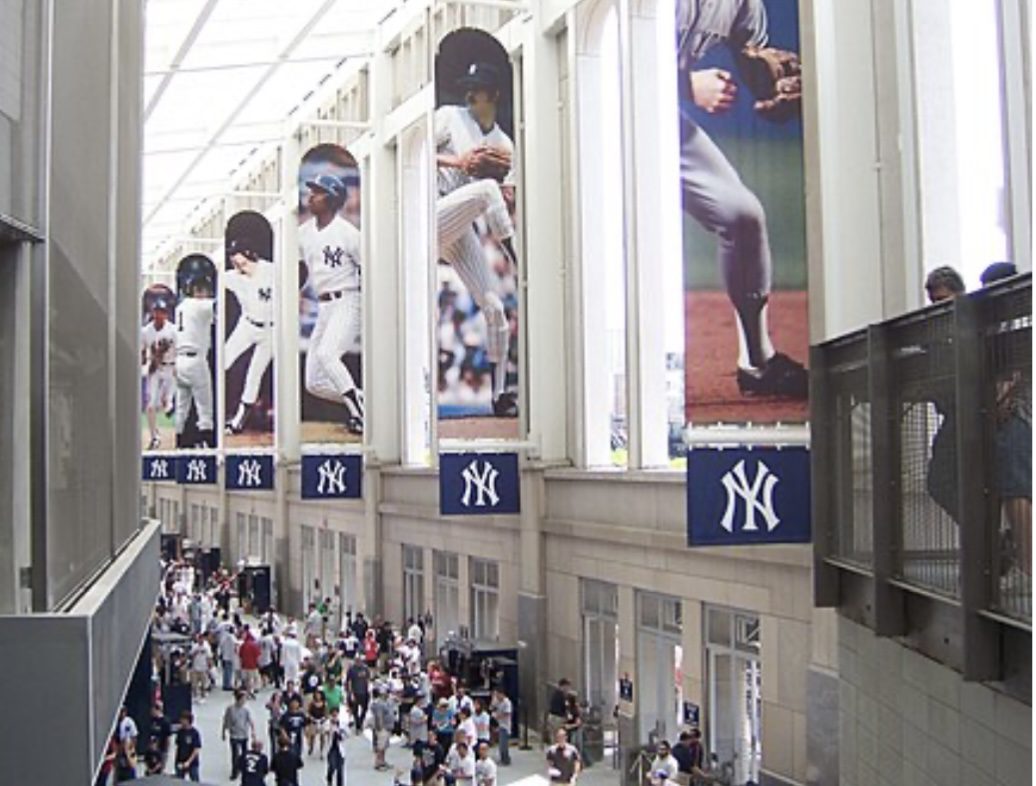
The facade is adorned with a striking V-shaped name. The interior is enhanced with hundreds of photos that reflect the team’s history, including a collection of over 2,000 images compiled in collaboration with the New York Daily News.
The seats are also arranged similarly to the stands of the original stadium. They are simply more comfortable and have more legroom than the previous ones. The maximum seating capacity is 52,325, with most seats concentrated in the lower section.
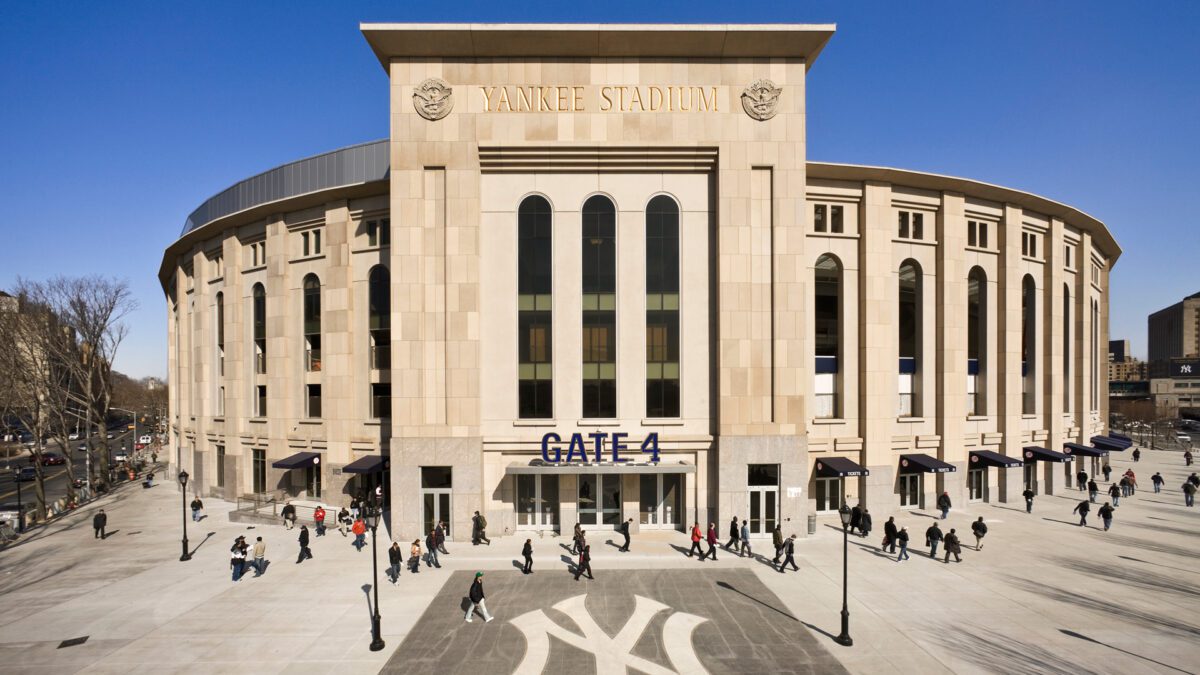
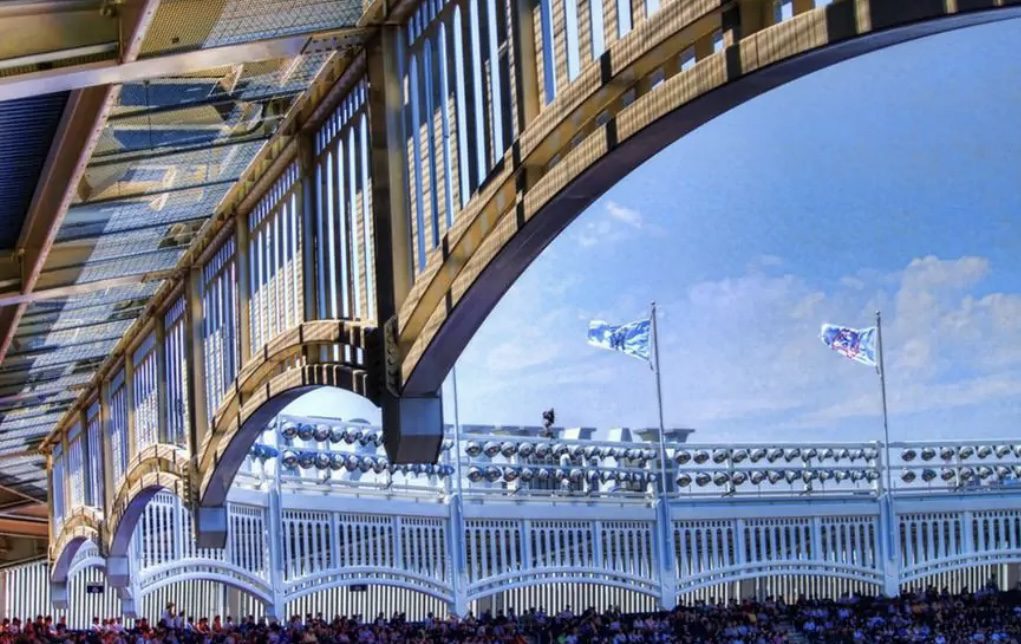
The decorative frieze that graced the roof of the old stadium from 1923 to 1973 was also recreated. It is made of steel and protected from corrosion.
The hand-operated auxiliary scoreboard was placed in the same location as it was before, but it was replaced with digital billboards before the 2022 season.
Between the outer wall and the inner part of the stadium is the “Great Hall”—a huge open space between Gates 4 and 6. This hall with seven-story ceilings is the largest open public entrance at a sports venue in the world, covering over 31,000 square feet of retail space and decorated with 20 banners featuring famous players. A huge LED display is also installed here.
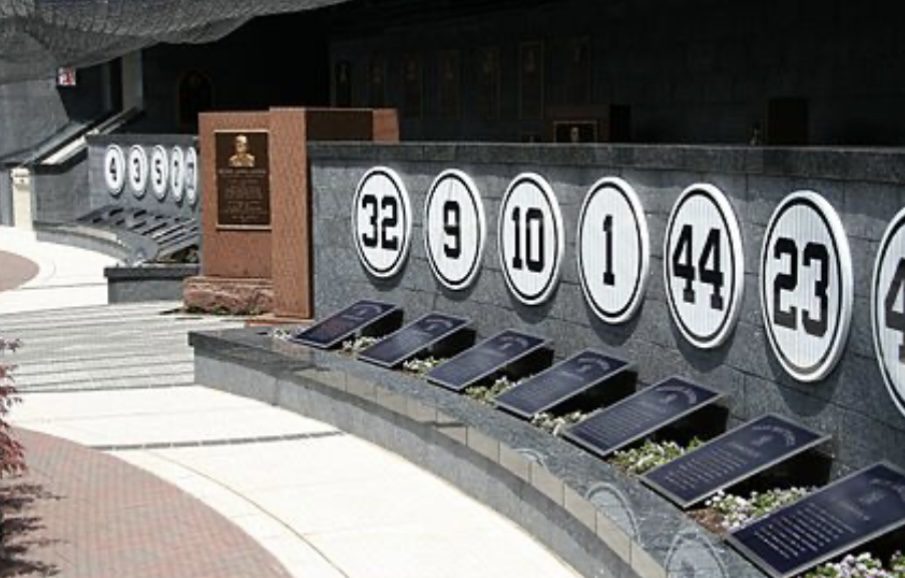
Monument Park, which contains the numbers of former players and monuments to prominent team members, was moved from the left field of the old stadium to a new location behind the center field of the new stadium. It is now located under a sports bar, and black curtains cover the monuments during games to avoid distracting spectators.
Why Playing at Yankee Stadium is Unusual Even for Experienced Baseball Players
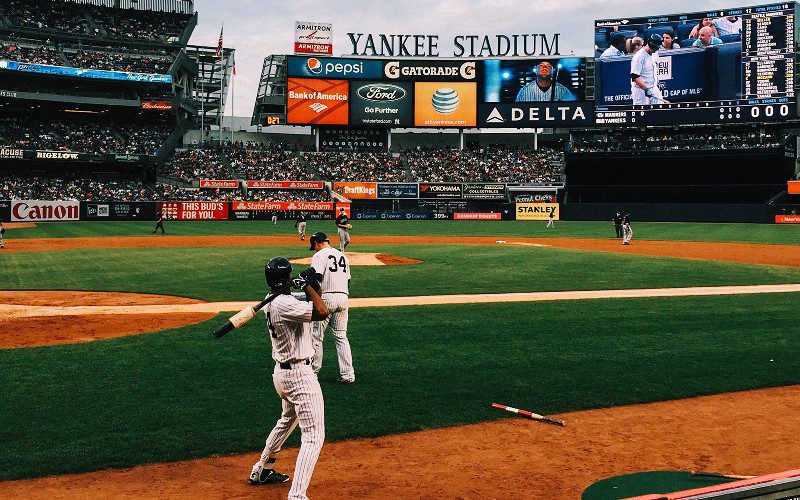
A distinctive feature of both the old and new Yankee Stadium is the shifted right field boundary. It is located closer to home plate than at other arenas. The reason for this is the railroad tracks that run alongside it. Although it would have been possible to create standard boundaries when building the new stadium, the project managers decided to preserve this unique quirk of the Yankees.
Thanks to the modified design of the right-field stands and a built-in manual scoreboard, the right field foul pole is on average 5 feet (1.5 m) closer to the main plate. Overall, the distances to the fence are 318 feet (97 m) to left field, 399 feet (122 m) to left-center field, 408 feet (124 m) to center field, 385 feet (117 m) to right-center field, and 314 feet (96 m) to right field. This creates a difference of up to9 feet (2.7 m) at certain points between the right field markers. The dimensions of the left field have remained virtually unchanged, despite the built-in auxiliary scoreboard.
Experienced players take this feature into account and use it when playing at Yankee Stadium. Left-handed batters are more likely to hit home runs in this field.
Everything is Thought Out Down to the Smallest Detail
The new stadium has 63% more space than its predecessor, with more spacious concourses and open viewing areas. The building is wired with 365 km of Ethernet cable and enough fiber optic cables for Cisco Vice President David Holland to call it “future-proof.” The stadium has over 1,100 high-definition video monitors, and the baseball merchandise inside is estimated to be worth approximately $10 million.
The center field scoreboard, manufactured by Mitsubishi Diamond Vision, has a screen area of 550.5 m² (5,925 sq ft). At the time of its opening, it was the third-largest HD scoreboard in the world. The Yankees’ clubhouse has an area of 2,880 m² (31,000 sq ft), which is more than 2.5 times larger than the previous clubhouse. The 310.7 m² (3,344 sq ft) locker room is equipped with safes and touchscreen computers. The clubhouse has a gym, training rooms, a video room, and a lounge area. The Yankees’ therapy room includes a hydrotherapy pool with an underwater treadmill. The Yankees are believed to be the first team to treat their uniforms and showers with antibacterial agents to reduce the risk of infection.
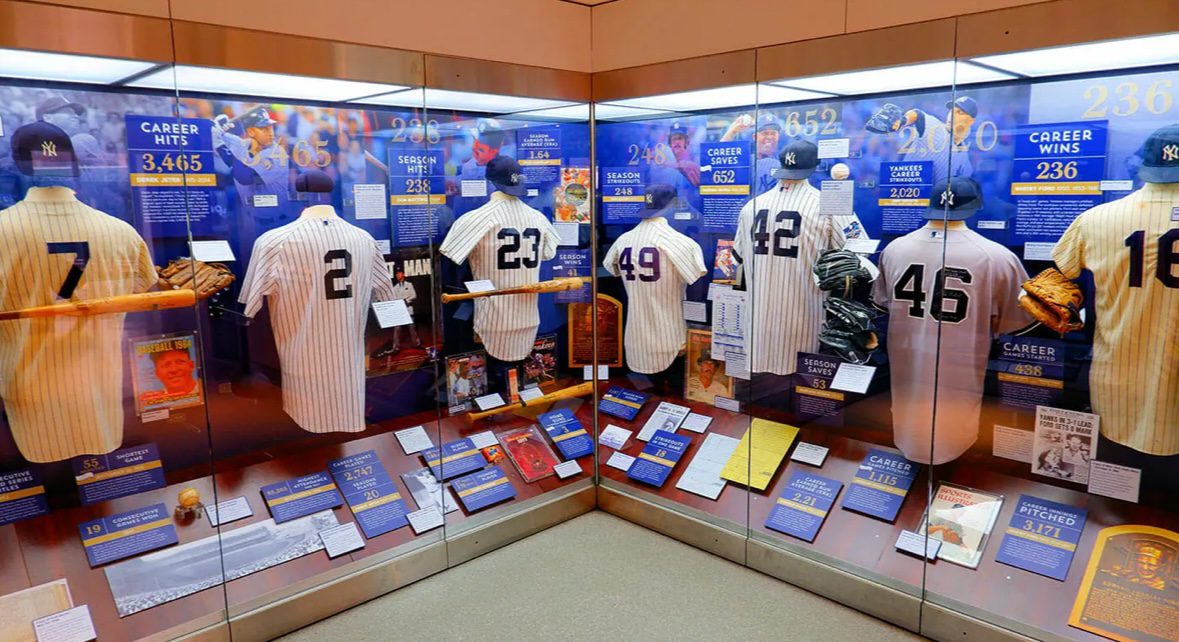
The “Ball Wall” contains hundreds of baseballs with the autographs of former and current players. A large museum is located on the lower level.
The food court area is also impressive, with 25 stationary restaurants and 112 mobile food stands. In May 2022, the “Yankee Stadium Tower Garden” was opened—a vertical aeroponic garden that grows fresh produce for players and fans.
Read about another interesting program with similar vertical gardens for schools in this article.
Today, Yankee Stadium is one of the main landmarks of the Bronx. It is always crowded with tourists and baseball fans. It also occasionally hosts college football games, such as the annual Pinstripe Bowl, and often serves as a venue for various concerts, other sporting events, and entertainment.
Read the article about the best NFL game ever played at Yankee Stadium by following this link.