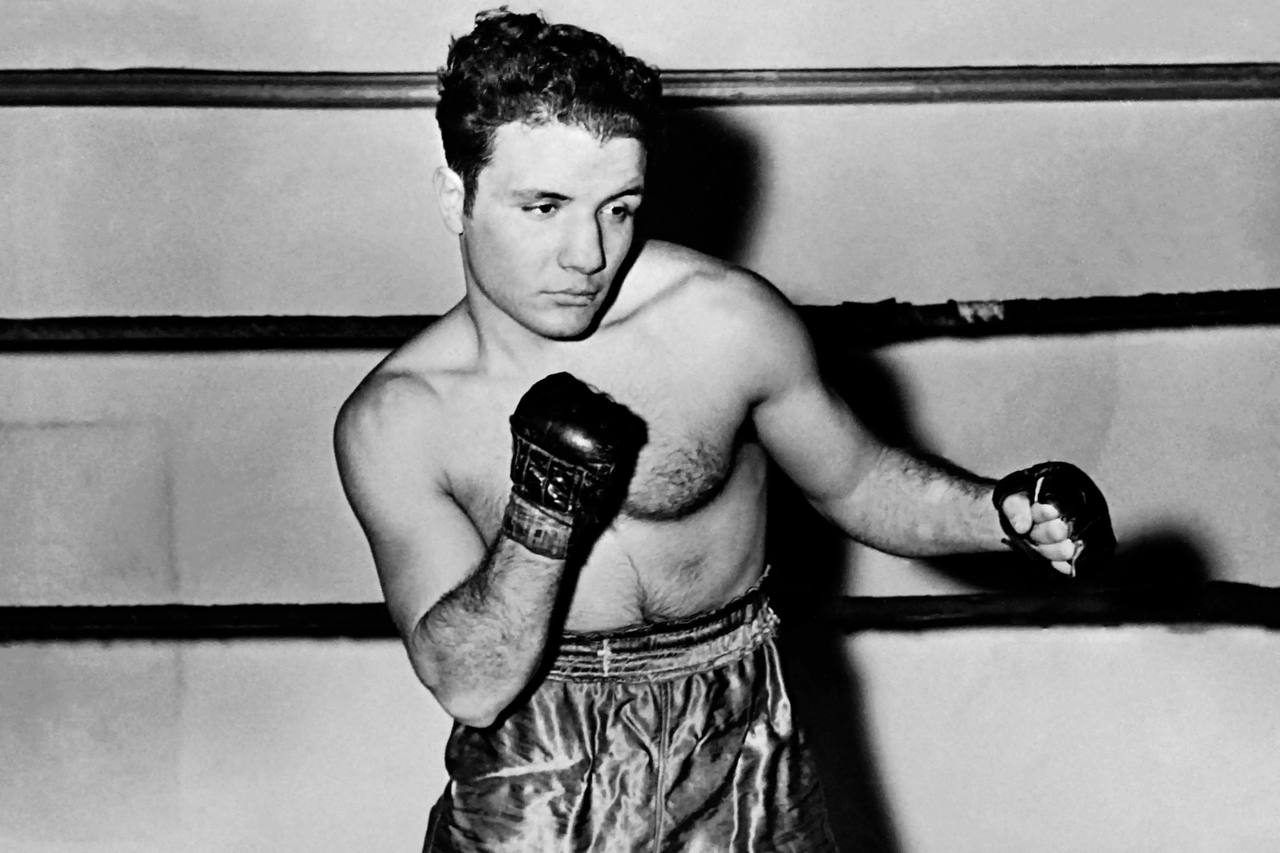

A renowned American boxer from the Bronx, he earned the middleweight world champion title. He’s considered one of the most vibrant and, at the same time, controversial figures in 20th-century sports. His challenging life story became the basis for the famous film “Raging Bull,” starring Robert De Niro. Read on for more about this boxer’s life and career on i-bronx.com.
The Bronx Brawler
Born on July 10, 1922, in the Bronx, Jake LaMotta was a true street fighter from an early age. His explosive temper and natural inclination for conflict didn’t go unnoticed. His father even turned it into a peculiar business—making his son fight in improvised rings right in their backyard, where other neighborhood residents would toss small coins for the spectacle of fights between teenagers. These pennies often went towards paying the family’s bills.
For young Jake, fighting wasn’t just a game—it was a way to survive, assert himself, and make money.
“I fought constantly—with someone just because, with someone for money, and sometimes just because I couldn’t help it,” he recalled many years later in an interview with the New York Daily News.
This restless nature soon led Jake into serious trouble. An attempted jewelry store robbery landed him in a reformatory. It was there that he first systematically started boxing.
By the age of 19, Jake had not only the hardened character of a street brawler but also a well-developed fighting style.

The Ups and Downs of “The Bronx Bull”
The early 1940s marked Jake LaMotta’s springboard to boxing fame. On March 3, 1941, he made his professional debut, steadily carving his path to the top with each fight. His list of victories was impressive: Fritzie Zivic, Tony Janiro, Holman Williams, Tommy Bell, Lloyd Marshall, Bob Satterfield, Jose Besora—and even Sugar Ray Robinson. Yet, despite this, the door to a championship title remained closed for him.
The reason was simple and dangerous: Jake refused to play by the rules of the Mafia, which then controlled a significant portion of the boxing business.
“I was the uncrowned champion for five years,” LaMotta said. “But no one would give me a shot. Time was passing, I was getting older, becoming less dangerous. I had to choose: either lose to Fox or remain without a title. They offered me $100,000. I refused. All I wanted was a chance.”
Ultimately, he agreed to a fixed loss, which resulted in a seven-month disqualification but finally moved things forward.
And then—the long-awaited chance. On June 16, 1949, in Detroit, Jake LaMotta met champion Marcel Cerdan. In the very first round, Jake knocked his opponent to the canvas. Cerdan, injuring his shoulder, fought with one arm until the ninth round, after which he refused to continue. LaMotta became world champion. Jake was forced to give a portion of his earnings to the Mafia. A rematch was planned, but Cerdan died in a plane crash en route to New York.

In 1950, LaMotta defended his title twice—first, by defeating Italian Tiberio Mitri, and then in a spectacular fight against Laurent Dauthuille. Losing on all counts, Jake gathered his last strength in the 15th round and knocked out the Frenchman at the 2:47 mark. This was typical LaMotta—undying, fearless, and stubborn to the very end. That confrontation earned the title “Fight of the Year.”
By 1954, LaMotta had entered the ring several more times but lost three of seven bouts and eventually retired with 83 wins (30 by knockout), 19 losses, and 4 draws.
Outside the ring, LaMotta lost control of his own life. He himself said: “I was like Dr. Jekyll and Mr. Hyde. In the ring, I was one person; at home with my kids, I was completely different. When my career ended, it became hard to separate those two. I started lashing out at my wives just like I used to at my opponents.”

This inner turmoil led him into darkness. In 1958, Jake was sentenced to six months in prison for involvement with minors in a nightclub he owned in Miami. Years of hardship followed. Sporadic film roles and attempts at public speaking brought no income. Things got so bad that one Christmas, LaMotta was wandering around New York with 35 cents in his pocket, ashamed to go home—he couldn’t afford a Christmas tree or presents.
Thus ended the era of one of the toughest boxers of the 20th century—a legend who punched his way through life but ultimately couldn’t stand up to the weight of his own shadow.
Legendary Rivalry with Sugar Ray Robinson
Boxing history knows many famous rivalries, but the duel between Jake LaMotta and Sugar Ray Robinson is a separate chapter, written in blood, sweat, and iron endurance.
These two first met in 1942, with Robinson winning by decision. But LaMotta wasn’t one to back down. A few months later, in February 1943, he did what no one else could: he inflicted Robinson’s first professional defeat after 40 consecutive wins. It was a major sensation—LaMotta literally threw his opponent out of the ring. Their fights were frequent and brutal: two clashes—just three weeks apart in 1943, and two more in 1945. LaMotta was aggressive, relentless, fighting like a lion, but Robinson consistently prevailed, winning by decision.

The culmination of this epic rivalry was their last fight on February 14, 1951—a bout that went down in history as the “St. Valentine’s Day Massacre.” At the old Chicago Stadium, before a crowd of fans, LaMotta once again challenged Robinson. He fought in his characteristic style—attacking, pressing, punching. In the 11th round, he even cornered his opponent and seemed close to victory. But his strength gave out.
“That was my last flurry of attacks,” he later confessed. “I couldn’t lift my arms anymore.”
Robinson seized the moment and began methodically breaking down Jake. In the 13th round, the referee stopped the fight. LaMotta could no longer defend himself, hanging on the ropes. But, crucially, he didn’t fall. And when the winner was announced, LaMotta managed to utter the legendary phrase:
“You didn’t knock me down, Ray! You didn’t knock me down!”
Though fierce rivals in the ring, outside it, Jake and Sugar shared respect, even friendship. Robinson was a witness at one of LaMotta’s weddings, and Jake himself joked:
“My three toughest opponents? Sugar Ray Robinson, Sugar Ray Robinson, and Sugar Ray Robinson again. We fought so many times, I’m surprised I don’t have diabetes yet.”
Autobiography and Late Recognition
In 1970, Jake LaMotta decided to tell it like it was. In his autobiography, “Raging Bull: My Story,” he held nothing back about his rage or the darker sides of his personal life: pathological jealousy, domestic abuse, and self-doubt. The book was raw, unvarnished.
But the real impact came ten years later, when in 1980, Martin Scorsese brought the story to the big screen. In the lead role was Robert De Niro, who literally transformed into LaMotta. He gained weight, mimicked LaMotta’s mannerisms, tone, and walk, ultimately winning an Oscar for Best Actor. The film “Raging Bull” showcased not only LaMotta’s boxing prowess but also his self-destruction. The camera didn’t flinch: scenes of domestic violence, emotional breakdowns, and rage against the world became the heart of this movie.

LaMotta himself wanted to play himself in the film, but the producer replied:
“Jake, you’re not the same anymore.”
Despite the unflattering portrayal in the film, the movie brought Jake back into the spotlight. Capitalizing on this newfound interest, in 1986 he released a memoir sequel—”Raging Bull II.”
Subsequently, Jake LaMotta was officially inducted into The Ring magazine’s Boxing Hall of Fame. It wasn’t a grand ceremony—rather a modest dinner at a Manhattan restaurant.
“It wasn’t a room in Madison Square Garden, but it was enough for me,” LaMotta wrote in his second book.
In 1990, Jake became one of the first inductees into the newly established International Boxing Hall of Fame in Canastota. This was an official, belated rehabilitation—not just sporting, but personal too.

Personal Life, Later Years
After his boxing career ended, Jake LaMotta didn’t disappear from public life. He opened a nightclub in Miami Beach, where he himself performed—not just as a host, but also as a comedian and singer. His life remained turbulent outside the ring. LaMotta testified before the Senate during an investigation into fixed fights and tried his hand at acting. He can be seen in a cameo as a bartender in the film “The Hustler” starring Paul Newman.
However, his personal life continued to test the boxer. In 1998, he lost both sons from his second marriage—Jack died of cancer, and Joseph died in a plane crash a few months later.

Yet, despite the losses and his age, LaMotta remained active: appearing at public events, signing autographs, and selling his own line of pasta sauces. At 90, Jake even played himself in the autobiographical show “Lady and the Champ,” which ran Off-Broadway. In 2016, at the Newport Film Festival, another film about him, “Bronx Bull,” premiered, starring William Forsythe, Paul Sorvino, and Joe Mantegna.
The legendary fighter passed away on September 19, 2017, in Miami, at the age of 95, from complications after pneumonia. Despite enduring 106 brutal fights, his mind remained sharp: even in old age, he gave lively interviews—honest, ironic, and witty.